Disclaimer For educational purposes only. Do not use as medical advice
AboutChinese MedicineCaution/Notes
| Health Benefits |
| For: Irritable Bowel Syndrome (IBS) • Chronic Gastritis • Uterine Fibroids • Duodenal Ulcer • Diabetes |
| Atributes: |
| Category: Tonify Qi |
| Subcategory: Source: Tai Ping Hui Min He Ji Ju Fang |
| Actions: Tonify qi • Strengthens spleen • Strengthens stomach |
| Diagnosis |
| Tongue: pale Pulse: weak Other:pale complexion |
| Patterns: Qi Deficiency, Spleen Qi Xu, Stomach Qi Xu |
| Indications: SP/ST Qi deficiency [35] • Key symptoms: pale complexion, poor appetite, short of
breath, fatigue, pale tongue with white coating, weak pulse[31] |
| Contraindications: Excess heat or deficient heat • Bloated, thirsty, and constipated at the same time • Other diabetes medication • Long term use |
| Description |
| Name Variations: Si Jun Zi Tang, 四君子汤, Four Gentlemen Decoction, |
| Herb List: Ren Shen(K, 3-9g) • Bai Zhu(M, 6-9g) • Fu Ling(A, 6-9g) • Gan Cao(G, 3-6g) • 参术苓加甘草 |
| Commentary: Basic formula for warming the Middle Jiao.[Song] Ren Shen tonifies (add to skill set) all types of Qi. Can replace Ren Shen with Dang Shen (less potent). Bai Zhu invigorates (inspires) Qi and dries dampness. Fu Ling drains dampness. Gan Cao harmonizes. • YI GONG SAN: a pediatric formula. Tonify Qi, strengthen SP, move Qi. Very gentle. For SP/ST Qi Xu and Yu, loose stool, poor appetite, epigastric discomfort. Middle Jiao Qi Xu. • LIU JUN ZI TANG: tonify Qi, strengthen SP, resolve Phlegm. SP/ST Qi Xu + Phlegm, poor appetite, loose stools, vomiting, epigastric discomfort. Usually more suitable than Si Jun Zi Tang. Same as Si Jun Zi Tang + Er Chen Tang • XIANG SHA LIU JUN ZI TANG: SP/ST Qi Xu + Phlegm + Qi Stagnation. Tonify Qi, strengthen SP, resolve phlegm, move Qi. Vomiting, fatigue, poor appetite, abdominal distention, epigastric discomfort. Golden Flower Salvia 10 is based on Liu Jun Zi Tang and it includes treatment for anxiety (Suan Zao Ren Tang). |
Related Formulas: Bu Dai Wan, Liu Jun Zi Tang, Shen Ling Bai Zhu San, Shi Quan Da Bu Tang, Yi Gong San, Ba Zhen Tang, Xiang Sha Liu Jun Zi Tang, Jian Pi Wan, Gui Pi Tang, Zhi Shi Xiao Pi Wan, Zi Sheng Wan
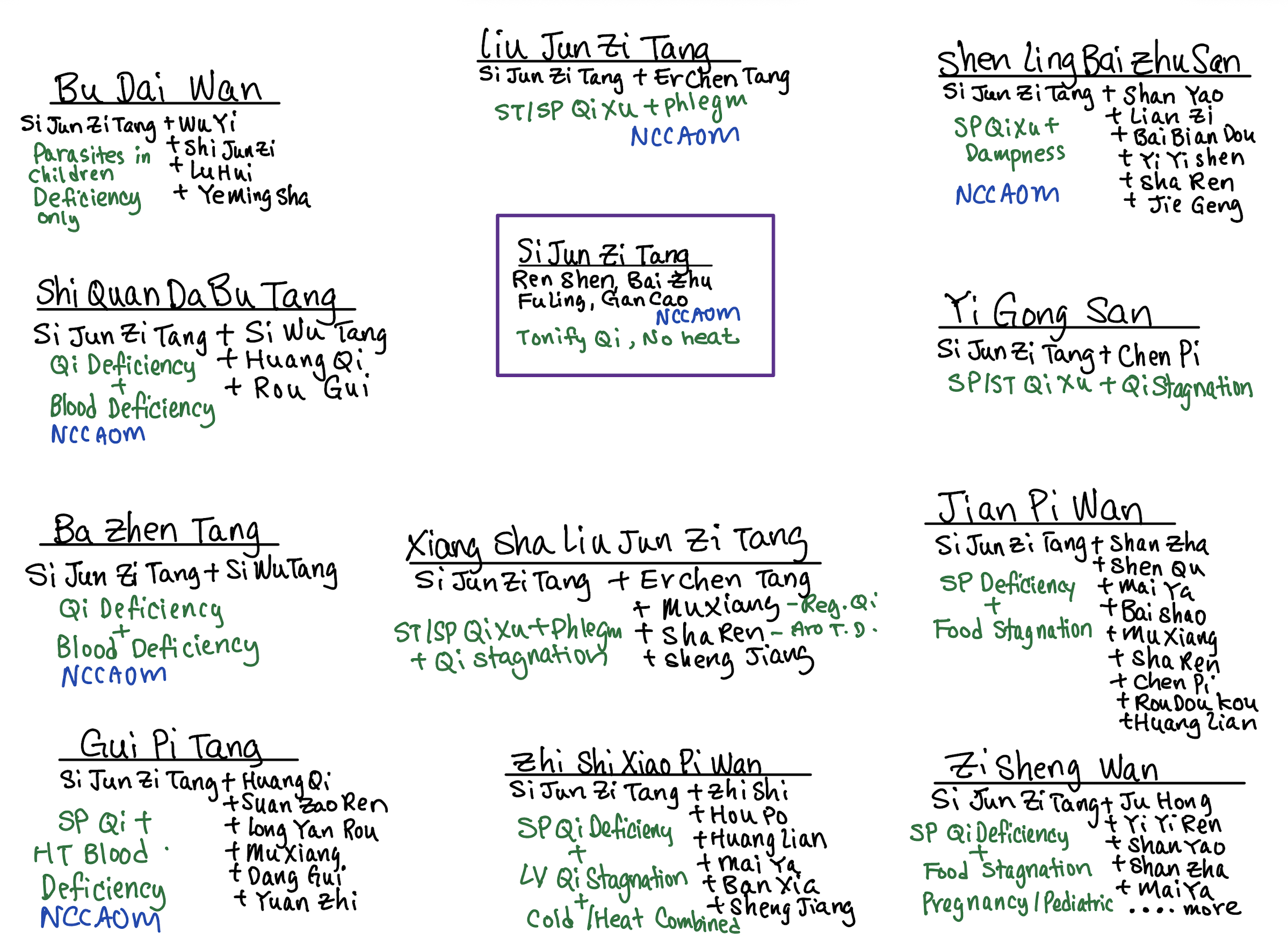 |
| NCCAOM: The 6 NCCAOM formulas for Qi Deficiency are Sì Jūn Zǐ Tāng, Liù Jūn Zǐ Tāng, Shēn Líng Bái Zhú Sǎn, Bǔ Zhōng Yì Qì Tāng, Yù Píng Fēng Sǎn, and Shēng Mài Sǎn. • Si Jun Zi Tang is for Spleen/Stomach Qi deficiency (poor appetite, shortness of breath, fatigue) • Liu June Zi Tang is for Spleen/Stomach Qi deficiency + phlegm. • Shen Ling Bai Zhu San is for SP Qi Deficiency + dampness causing diarrhea. • Bu Zhong Yi Qi Tang is for Spleen/Stomach deficiency causing intermittent fever or Spleen Qi Sinking (prolapses). • Yu Ping Feng San is for Wei Qi deficiency causing sweating. For frequent common colds and aversion to wind. • Sheng Mai San is for Lung Qi and Yin deficiency with spontaneous sweating. Chronic cough. |
| Herbs |
Cat/Dosage |
Actions |
Attributes |
| Ren Shen • Ginseng • 人参 ♠ |
Tonify Qi |
Tonify yuan qi • Tonify lung qi • Tonify heart qi • Calms Shen • Stop thirst • Helps impotence • Treats qi collapse • Tonify Spleen • Generate fluid • Stop thirst • Strengthen anti-pathogenic qi • Can go to all 5 zang organs |
adaptogen • anti-aging • anticoagulant • antiplatelet • antioxidant • adrenalcortical • immunity booster • anti-inflammatory • antidepressant • hepatoprotective • stimulant |
| Bai Zhu • White Atractylodes Root • 白术 ♠ |
Tonify Qi |
Tonify Middle Jiao Qi • Calms fetus • Dry dampness • Stabilize exterior to stop sweatingDao Di: Zhe Jiang |
Anti-inflammatory • Hepatoprotective • Immunity Booster • Hypoglycemic • Antibaterial |
| Fu Ling • Poria Mushroom • 茯苓♣ |
Drain Dampness |
Dry dampness • Tonify spleen • Calm spirit • Relief edema • Detox food poisoning • Promote urination Dao Di: Yun Nan |
Diuretic • Antibacterial • Anti-inflammatory • Anti-allergic • Hypoglycemic • Antacid • Sedative • Immunity booster |
| Gan Cao • Licorice Root • 甘草♦ |
Tonify Qi |
Tonify Spleen Qi • Tonify Heart qi • Clear heat • Resolve toxicity • Stop cough • Dispel phlegm • Lubricate lungs • Stop wheezing • Reduce spasm • Relieve pain • Harmonize other herb effects • enters 12 channelsEnters all 12 channels, often serve as envoy in a formula. |
Hypoglycemic • Antiarrhythmic • Hypertensive • Expectorant • Antidiarrheal • Antiulcer • Hepatoprotective • Immunostimulant • Antitussive • Antiviral • Detox • Demulcent • Anti-inflammatory • Laxative • Emmenagogue • Antimicrobial • Spasmolytic • Corticosteroidal |
| ♠ King/Chief ♥ Minister/Deputy ♣ Assistant ♦ Envoy |
| Directions: |
| Modifications |
For |
| + Ban Xia |
Vomiting 31 |
| + Zhi Ke, Chen Pi |
Chest or epigastric distention31 |
| + Suan Zao Ren + Yuan Zhi |
Insomnia, palpitations31 |
| + Gan Jiang + Fu Zi |
Fear of cold, cold limbs, cold pain 31 |
| Caution |
|
ALERT: Contraindications of each herb - use with caution under these conditions:
Ren Shen: Blood thinner medication • Diabetes medication • Blood pressure medication • Caffeine • Yin deficiency • Stagnant fire • Hypertension • Bleeding disorders • Pain in chest • Excess heat • food: onion, garlic, radishes, tea, turnips
Bai Zhu: Autoimmune disorder • Yin deficiency with heat • Dehydration • Foods: black carp, Chinese cabbage, peach, plum and coriander
Fu Ling: Foods: Vinegar, pickled food
Gan Cao: High blood pressure • Low potassium • Seaweed • Medications: Gan Cao can interact with various medication. See Pharma Interaction section. |


0 Comments